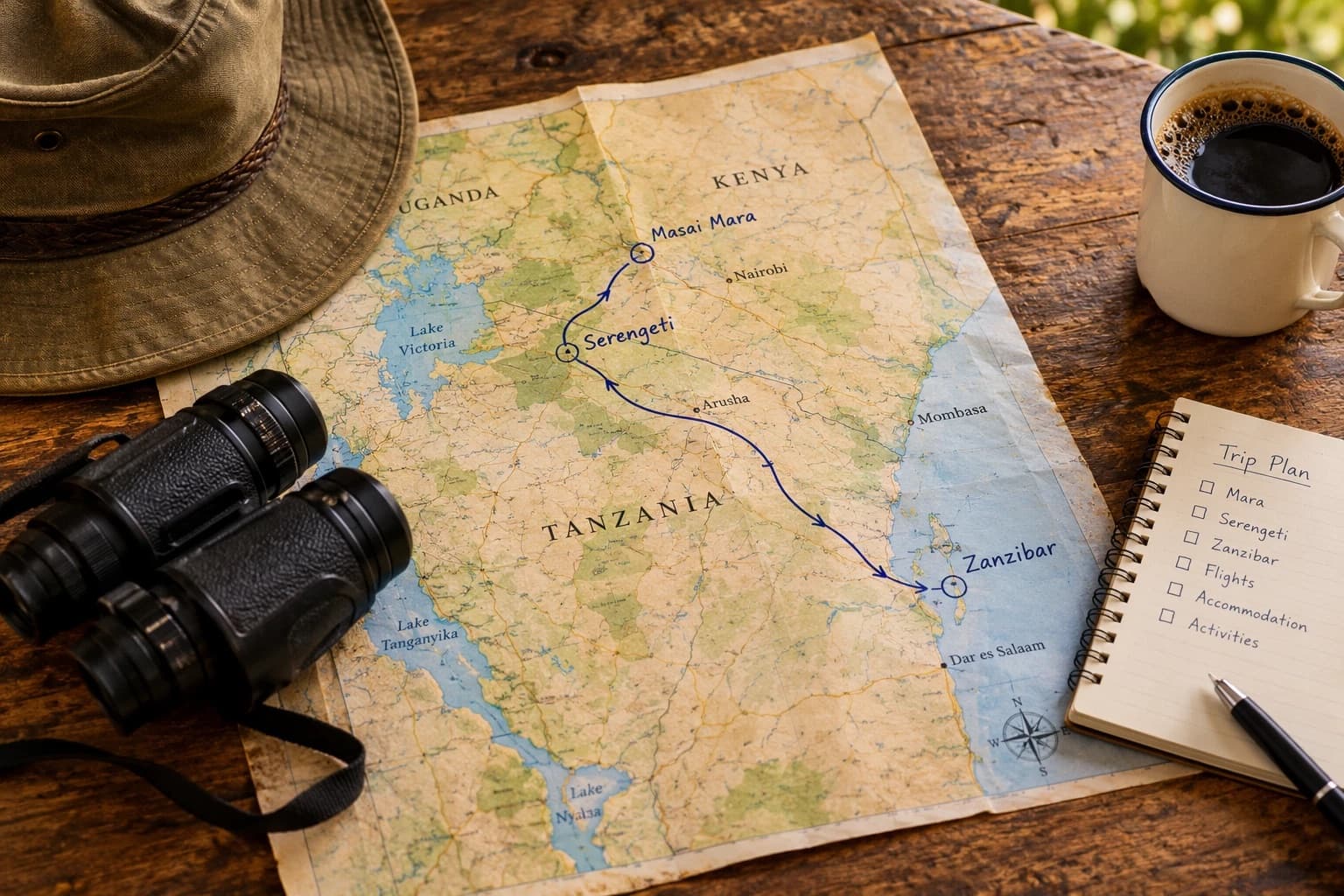
The Great Migration is the endless loop made by well over a million wildebeest, joined by hundreds of thousands of zebra and gazelle, through Tanzania’s Serengeti and Kenya’s Maasai Mara. It is often called the greatest wildlife show on earth, and it never stops: at any time of year the herds are somewhere in the ecosystem, following the rain to fresh grass. This guide explains why they move, where they are likely to be each month, and how to plan a trip that puts you in the right place.
What the migration is
The Serengeti and the Maasai Mara are two halves of one great ecosystem, divided only by an international border that the animals do not recognise. Serengeti National Park alone covers almost 15,000 square kilometres, and together with the Ngorongoro Conservation Area, the Maasai Mara and the surrounding reserves and conservancies it forms one of the largest intact grassland systems in the world.
The most common misunderstanding is that the migration happens on a set date, like a parade. In reality it is a continuous, year-round movement, and its timing shifts from year to year depending on when and where the rains fall. The herds spend most of the year in Tanzania, crossing into the Maasai Mara for a few months in the dry season before returning south. There is no single ‘migration season’: each stage has its own drama.
Blue wildebeest, also called brindled gnu, make up the bulk of the herds, alongside plains zebra and Thomson’s gazelle. In all, around two million animals are on the move, making it the largest overland migration of large mammals anywhere on earth.
Why the herds move
The migration is driven by rain, grass and water. During the wet season the short-grass plains of the southern Serengeti, which grow on rich volcanic soils, provide some of the most nutritious grazing in Africa, ideal for mothers feeding newborn calves. When those plains dry out, there is no permanent water, and the herds must move north and west towards areas with more reliable rainfall and rivers.
Wildebeest and zebra also help each other. Zebra tend to crop the taller, coarser grass, which exposes the shorter, fresher growth that wildebeest prefer. Gazelles follow behind to feed on the shortest shoots. Their combined grazing keeps the grasslands healthy, and their sheer numbers mean that predators can only ever take a small share.
Where the herds usually are
| Months | Where | What to expect |
|---|---|---|
| December to March | Southern Serengeti and Ndutu | Calving season. Around half a million calves are born, most in a few weeks around February, with intense predator action. |
| April to May | Central and western Serengeti | The long rains. Herds begin moving north and west; few visitors, green landscapes and lower prices. |
| June to July | Western corridor and northern Serengeti | Herds gather and cross the Grumeti River, then push north. |
| July to October | Northern Serengeti and Maasai Mara | Mara River crossings, usually most frequent in August and September. |
| November | Eastern and central Serengeti | The short rains draw the herds back south towards the calving grounds. |
These are typical patterns, not guarantees. We follow reports from guides on the ground and place you where the herds are most likely to be during your dates.
December to March: the calving season
After the short rains, the herds spread across the short-grass plains of the southern Serengeti and the Ndutu area on the edge of the Ngorongoro Conservation Area. Here, in a remarkably short window around February, the wildebeest give birth to around half a million calves. Calving in such a concentrated burst is a survival strategy: predators simply cannot eat them all.
A newborn wildebeest can stand within minutes and run with the herd within a day or two. Even so, the plains become a hunting ground. Lions, spotted hyenas and cheetahs are extremely active, and this is one of the best times of the year to see a cheetah hunt in open country. The landscapes are green, the light is clear after rain, and visitor numbers are far lower than in the peak dry season.
This is a favourite time for photographers, and it is the reason our 13-Day Photographic Safari includes Ndutu.
April and May: the long rains
As the plains dry out and the long rains arrive, the herds begin to drift north and west through the central Serengeti and towards the western corridor. Long columns of wildebeest, sometimes stretching for kilometres, move across the landscape, and the rutting season begins, with males noisily defending small territories.
This is the quietest time to visit. Some camps close, roads can be muddy and you should expect showers, but the rain usually falls in heavy afternoon bursts rather than all day. In return you get lush landscapes, dramatic skies, very few vehicles and lower prices. It is a rewarding season for experienced travellers who value solitude.
June and July: the Grumeti River
By June the herds gather in the western corridor, a long arm of the Serengeti that stretches towards Lake Victoria. Here they must cross the Grumeti River, whose pools hold some of the largest Nile crocodiles in Africa. The Grumeti crossings are less famous than those on the Mara, but they can be just as dramatic.
From late June and into July the front of the migration pushes north towards the Kenyan border. The dry season has begun, the grass turns golden, and the herds become more concentrated as they search for water.
July to October: the Mara River crossings
The river crossings in the northern Serengeti and the Maasai Mara are the most famous part of the year. As the herds move between Tanzania and Kenya, they must cross the Mara River, and in the Maasai Mara the Talek River too, sometimes several times in each direction.
A crossing can take hours or days to begin. Herds build up on the banks, nervous and restless, while crocodiles wait below and lions watch from the long grass. Then, often after a single animal takes the plunge, thousands follow in a rush of dust, water and noise, leaping down steep banks and swimming against the current. Some are taken by crocodiles, some drown or are injured on the far bank, and predators wait on both sides.
Crossings usually happen between July and October and are most frequent in August and September, but they cannot be predicted to the day. Patience matters: the best sightings often come to those who wait quietly at a distance rather than racing between crossing points. In peak season many vehicles gather at the most popular points, so a well-placed camp and an experienced guide make a real difference.
The Kenyan side offers a useful alternative to the busy main reserve: private conservancies bordering the Maasai Mara limit the number of vehicles and allow activities such as walking and night drives that are not permitted inside the reserve itself.
November: the return south
When the short rains begin, usually in November, the herds start moving back south through the eastern side of the Serengeti, heading for the fresh grass of the southern plains. This is a transitional month, with herds strung out across a wide area. It can be an excellent time to travel, with fewer people and good wildlife across the central Serengeti.
The predators that follow
So much prey supports one of the greatest concentrations of predators on earth. The Serengeti is thought to hold around 3,000 lions, and spotted hyenas are even more numerous. Cheetahs do particularly well on the open plains, leopards hunt along wooded rivers and rocky outcrops, and Nile crocodiles wait at every crossing.
The scale of the cycle is hard to grasp. Around a quarter of a million wildebeest die each year from predation, drowning, exhaustion and disease, while around half a million calves are born. That turnover is what keeps this ancient system in balance, and it feeds everything from lions to vultures to the soil itself.
Our wildlife guide explains how each predator hunts and how to tell them apart.
Choosing where to stay
Because the herds move, where you stay matters more on a migration safari than on almost any other trip. There are three main approaches:
- Seasonal and mobile camps: lightweight tented camps that move two or three times a year to stay close to the herds. They offer the best chance of being in the right place.
- Permanent camps in key areas: well placed for a particular season, such as the northern Serengeti in the dry months or Ndutu for calving.
- A combination: two or three camps in different areas, joined by light-aircraft flights, so you can cover more ground and improve your odds.
We choose camps based on your dates, budget and interests, and on the latest reports from the field.
Planning tips
- Book early for July to September, when the best-placed camps fill first, often a year in advance.
- Allow enough time. Three or four nights in the right area gives you a far better chance of seeing a crossing than one or two.
- Combine the Serengeti with the Ngorongoro Crater, whose wildlife stays put all year, and with Tarangire, which is at its best in the dry season.
- Consider the quieter seasons. Calving (January to March) and the green season are superb for predators and photography, with far fewer vehicles.
- Fly in and drive out. A light-aircraft flight saves long road days, and a drive back through the park lets you see the landscape change.
- Think about Kenya too. The Maasai Mara and its conservancies are excellent from July to October and combine well with Amboseli or Laikipia.
- Add a hot-air balloon flight at sunrise for a view of the herds you will never forget.
Watching responsibly
At the crossings, behaviour matters. Vehicles that crowd the banks or block the herds’ approach can delay or even prevent a crossing, and sometimes push animals towards more dangerous points. Good guides keep their distance, stay on permitted tracks, switch off engines and let the animals decide. Following the park rules protects the spectacle for the animals and for everyone who comes after you.
Questions
When is the best time to see the Mara River crossings?
Crossings usually happen between July and October, most often in August and September. Timing depends on the rains, so build in several days in the northern Serengeti or the Maasai Mara.
Where is the migration in February?
In February the herds are usually on the short-grass plains of the southern Serengeti and Ndutu, where most of the year’s calves are born in a few weeks.
Can I see the migration in Kenya and Tanzania on one trip?
Yes. From roughly July to October the herds move between the northern Serengeti and the Maasai Mara, so a combined Kenya and Tanzania itinerary can follow them on both sides of the border.
Is the migration worth seeing outside the river-crossing season?
Absolutely. The calving season from about January to March is superb for predators and photography, and the green season brings dramatic landscapes and very few visitors. The herds are always somewhere in the ecosystem.
Related
- 9-Day Mara River Crossing Safari
- 13-Day Photographic Safari (calving season)
- 6-Day Maasai Mara and Amboseli Safari
Background reading: James Currie, The Great Tours: African Safari (The Great Courses with National Geographic), alongside the national park authorities. Wording is our own; check fees and rules with the parks before you travel.